

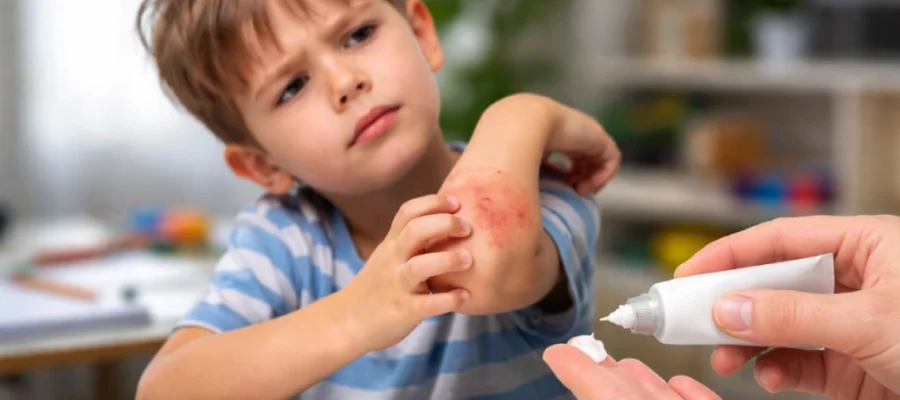
Many parents of children with eczema notice more than just itchy skin. They may also see poor sleep, irritability, emotional meltdowns, or trouble focusing, which naturally leads to questions about whether there is a link between eczema and ADHD.
It is also common for parents to worry about steroid creams after reading conflicting information online. The good news is that topical steroid creams, when used correctly, are not known to cause ADHD. In this blog, we will look at how eczema itself can affect a child’s behaviour, whether steroid creams can influence mood or attention, and how to treat eczema safely without unnecessary fear.
What is Eczema in Children
Eczema, also known as atopic dermatitis, is a very common inflammatory skin condition in children. It causes dry skin, intense itching, redness, irritation, and flare-ups that can come and go over time. Some children have mild patches behind the knees or elbows, while others have more widespread symptoms that interfere with sleep, school, and daily comfort.
The most important thing to understand is that eczema is not “just dry skin.” It is an inflammatory condition that can significantly affect quality of life, especially in young children who may not be able to explain how uncomfortable they feel.
Children with eczema often experience:
- Persistent itching
- Broken or inflamed skin
- Night-time waking due to scratching
- Fussiness or irritability
- Difficulty concentrating when symptoms are active
- Secondary skin infections in some cases
- Flare-ups triggered by heat, sweat, soaps, fabrics, dust, or allergens
This is where many parents begin to worry about behaviour.
Why Children with Eczema May Seem More Hyperactive or Distracted
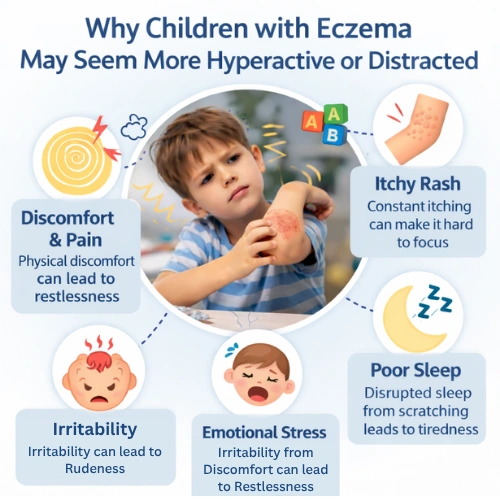
A child with active eczema may look very different from their usual self. They may be:
- More irritable than normal
- Unable to sit still because of itching
- Constantly rubbing or scratching
- More emotional or frustrated
- Tired during the day after poor sleep
- Less focused on school or play
- More impulsive or reactive when uncomfortable
These symptoms can sometimes resemble ADHD-like behaviour. However, that does not automatically mean the child has ADHD.
This is one reason why researchers have looked into atopic dermatitis and ADHD in recent years. Some studies have shown that children with moderate to severe eczema may be more likely to have attention or behavioural difficulties. But the relationship is complex. It does not prove that eczema directly causes ADHD, and it certainly does not mean every child with eczema is at risk of developing it.
In many cases, the more likely explanation is this:
- Chronic itching disrupts sleep
- Poor sleep affects mood, focus, and self-regulation
- Discomfort leads to restlessness
- Repeated flare-ups create stress for both child and parent
So what may look like a behavioural disorder can sometimes be the result of an untreated or poorly controlled skin condition.
Do Steroid Creams Cause ADHD?
There is currently no reliable evidence that properly used steroid creams for eczema cause ADHD in children.
Steroid creams are commonly prescribed to calm inflammation, reduce itching, and help heal eczema flare-ups. When used correctly, they are an important part of eczema treatment.
What matters is using them the right way:
- Choosing the appropriate strength for your child’s skin and age.
- Applying them to the affected areas as advised.
- Using them for the recommended duration.
- Keeping the skin moisturised to protect its natural barrier.
Like any medicine, steroid creams need to be used appropriately. Very strong steroids, when used over large areas or for long periods, can sometimes be absorbed into the bloodstream. That’s why it’s important to follow your doctor’s advice rather than avoid treatment out of fear.
Here’s something parents often overlook: eczema itself can affect a child’s behaviour. Constant itching, poor sleep, and discomfort can leave children tired, irritable, restless, and less able to concentrate. These behaviours can sometimes look like ADHD, but they do not necessarily mean a child has ADHD.
So, if your child has eczema, please don’t let fear of steroid creams stop you from treating their skin properly. Use the prescribed treatment, moisturise regularly, and speak to your doctor if you have concerns.
The goal is not to avoid steroids at all costs. It’s to use them safely, effectively, and when your child needs them.
Can Steroid Creams Affect Behaviour at All?
This is where the conversation needs nuance.
Parents often ask whether eczema steroids’ behavior side effects of eczema steroids are possible. In routine pediatric eczema care, behavioural side effects from standard topical steroid use are considered uncommon. Most children tolerate them well when they are prescribed appropriately and used as directed.
That said, any medication should still be used carefully. Factors that matter include:
- The potency of the steroid
- The area of the body being treated
- The child’s age
- How often is it used
- Whether it is being overused or used for too long
- Whether it is being applied under occlusion or on sensitive skin areas without supervision
If very potent steroids are misused, especially over large areas or for prolonged periods, systemic absorption can increase. This is why steroid creams should always be used under proper medical guidance.
But for the vast majority of children using standard eczema treatment plans, the bigger behavioural issue is usually the eczema itself, not the cream.
Why Untreated Eczema Can Affect Mood and Attention More Than Treatment
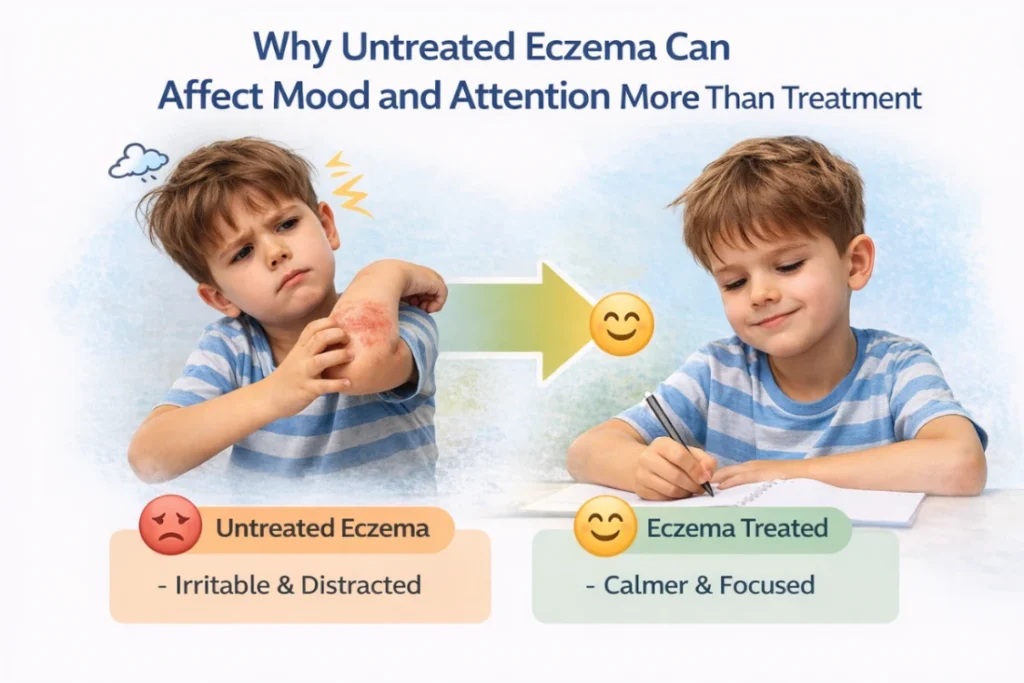
This is something parents often underestimate.
A child who is constantly itchy may:
- wake multiple times at night
- scratch until the skin bleeds
- feel embarrassed about visible rashes
- become clingy or frustrated
- struggle in nursery or school
- develop daytime fatigue
- have reduced tolerance for sensory discomfort
If a child is tired, itchy, and distressed every day, it is not surprising that they may seem more “hyper,” emotional, or difficult to settle.
This is why some parents notice a positive change in behaviour once eczema is properly controlled:
- better sleep
- less scratching
- less discomfort
- improved mood
- better daytime focus
- fewer meltdowns
Sometimes what appears to be a reaction to treatment is actually the opposite; the child is finally more comfortable.
Why Eczema Behaviour in Children Is Easily Misinterpreted
Parents are often very observant, and that is valuable. But sometimes timing can create confusion.
For example:
- A flare gets worse, and the child becomes more irritable
- Steroid cream is started during the same period
- The parent links the behaviour change to the cream, when the flare itself may be the real cause
Or:
- The child already has sleep deprivation from weeks of itching
- The parent notices poor attention and emotional dysregulation
- Online searches create fear around medications
This is why medical context matters. Not every symptom that happens “after starting treatment” is caused by the treatment.
When addressing concerns regarding the use of topical steroids and their potential impact on children’s behaviour, it is important to consider the following:
- how severe the eczema was before treatment
- sleep quality
- itch intensity
- school or nursery stress
- allergy triggers
- family history of ADHD or neurodevelopmental conditions
- whether the behaviour is persistent even when eczema is well controlled
Safe Use of Steroid Creams in Children with Eczema
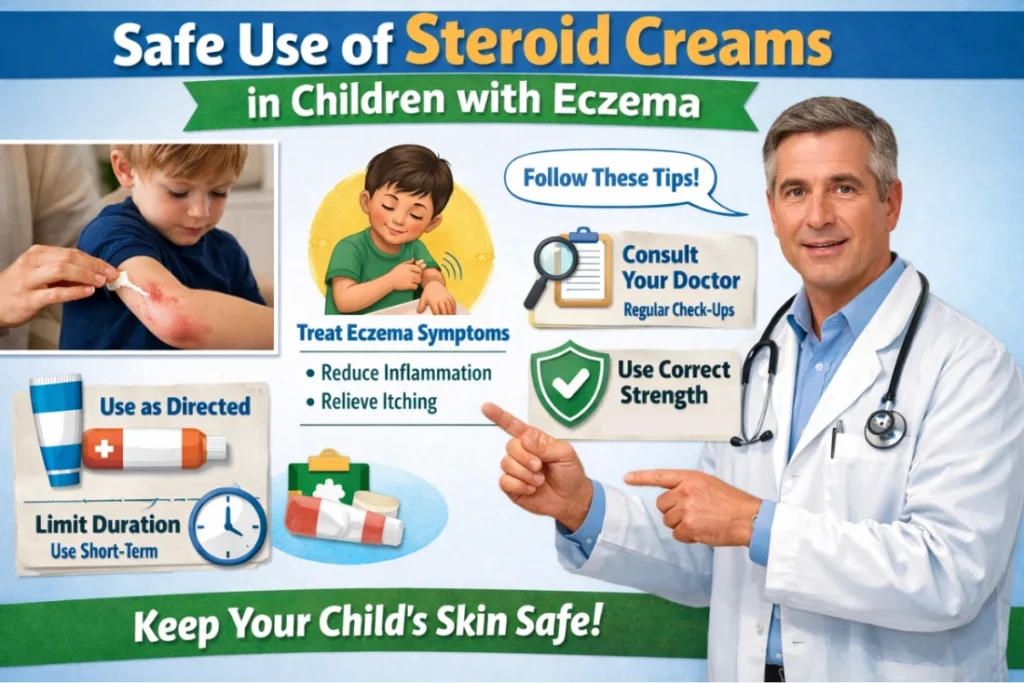
When prescribed by a pediatrician or pediatric allergy specialist, steroid creams can be very safe and effective. Parents can explore balanced options between safe steroid creams and natural remedies for baby eczema to keep treatment gentle yet proactive.
Key Principles for Using Steroid Creams Safely in Children
- Use the correct strength
Mild steroids are often used for the face or sensitive areas, while slightly stronger options may be used for thicker skin or more inflamed patches. - Use them for flare-ups, not forever
They are usually used in short courses to calm inflammation. - Moisturizers remain the foundation
Steroid creams treat active inflammation. Emollients help repair the skin barrier and reduce future flare-ups. - Avoid self-escalating treatment
Do not increase frequency, duration, or potency without medical advice. - Review recurring flares properly
If eczema keeps coming back, the answer is not always “more steroids.” It may mean trigger review, allergy evaluation, infection treatment, or a revised eczema plan.
If eczema keeps coming back, the answer is not always “more steroids.” It may require an expert review or allergy testing for eczema to uncover underlying environmental or dietary triggers.
When Behaviour Concerns Need Further Evaluation
Sometimes a child with eczema truly may also have attention or behavioural concerns that need separate assessment. Not every symptom should be explained away as “just eczema.”
Consider further evaluation if:
- Inattention continues even when eczema is well controlled
- Sleep has improved, but focus remains significantly affected
- Teachers report consistent concerns across settings
- There is impulsivity, hyperactivity, or emotional regulation difficulty beyond flare periods
- developmental or learning concerns are also present
A child can have eczema and still need a proper developmental or behavioural review. The key is not to jump to conclusions too early in either direction.
What Parents Should Do If They Are Worried
If you are worried that your child’s eczema treatment is affecting behaviour, the best approach is not to stop treatment abruptly on your own.
Instead:
- Take photos of the eczema during flare-ups
- Track sleep patterns
- Note behaviour changes and when they happen
- Record when steroid creams are used and for how long
- Observe whether symptoms improve as the skin improves
- Discuss concerns with a pediatrician who understands both skin inflammation and child behaviour
This helps separate fear from facts and gives you a clearer picture of what is really happening.
Final Thoughts
Eczema can affect a child’s sleep, mood, and behaviour, but that doesn’t mean steroid creams cause ADHD. In most cases, the right eczema treatment actually improves comfort, sleep, and overall well-being. The key is proper diagnosis, safe treatment, and understanding the real triggers behind your child’s symptoms.
If your child has recurring eczema, poor sleep, frequent flare-ups, or you’re concerned about changes in behaviour, book an appointment with Dr. Mahesh Katre today. today. Call or WhatsApp +971 55 232 9107.
Common Questions Parents Ask About Eczema and ADHD
1. Can eczema cause ADHD in children?
No, eczema does not directly cause ADHD. However, chronic itching and broken sleep can make children restless, tired, and irritable, leading to daytime inattention and hyperactivity that closely mimic ADHD symptoms.
2. Do topical steroid creams cause ADHD or behavioural changes?
There is no clinical evidence that appropriately prescribed topical steroid creams cause ADHD. Because topical steroids are applied directly to the skin in limited amounts, systemic absorption is very low compared to oral steroids. When used as directed by a paediatrician, behavioural side effects are uncommon.
3. Why does my child seem hyperactive or distracted when their eczema flares up?
Active eczema causes intense itching and frequent nighttime waking. Severe sleep deprivation, physical discomfort, and the constant urge to scratch lower a child’s sensory threshold, making them appear fidgety, emotionally dysregulated, and unable to focus.
4. Are steroid creams safe to use on babies and young children?
Yes, topical steroids are safe and effective when prescribed by a doctor. Safety depends on using the correct strength (mild steroids for the face/folds, slightly stronger for thick patches), applying them only for the recommended duration, and combining them with daily emollient moisturizers.
5. How do I know if my child has ADHD or if it is just eczema?
If attention problems, impulsivity, or restlessness persist across multiple settings (like school and home) even when the eczema is completely calm and sleep is restorative, a separate developmental or paediatric evaluation is recommended.