


When parents are already managing eczema, skin allergies, sneezing, or frequent flare-ups, it is easy to come across confusing information online. At the same time, many families start looking for long-term allergy treatment options that go beyond temporary relief, especially when symptoms begin to affect sleep, school, and daily comfort.
One option that often comes up is Sublingual Immunotherapy (SLIT), particularly for children with environmental allergies like dust mites, pollen, or pet dander. But is it effective, safe, and suitable for every child? In this blog, let’s break it down simply and practically so parents can understand the benefits, limitations, and when SLIT may be worth considering.
What Is Sublingual Immunotherapy (SLIT)?
Sublingual Immunotherapy, or SLIT, is a form of allergy treatment that helps the body become less sensitive to specific allergens over time.
Instead of just controlling symptoms with antihistamines or nasal sprays, SLIT works on the immune system itself. The child is given a tiny, carefully measured dose of the allergen in the form of drops or tablets placed under the tongue. This is usually done regularly over a long period, often months to years, depending on the child’s allergy profile and treatment plan.
The goal is simple:
- Reduce how strongly the body reacts to allergens
- Lower the frequency and severity of allergy symptoms
- Reduce dependence on medicines
- Improve long-term quality of life
In many children, this can be especially useful when allergies keep coming back despite avoiding triggers and using standard medication.
How Does SLIT Work in Children?
Children with allergies have an immune system that overreacts to things that should normally be harmless, such as:
- House dust mites
- Grass pollen
- Tree pollen
- Mould spores
- Pet dander (in selected cases)
With SLIT, the immune system is exposed to very small, controlled amounts of the allergen repeatedly. Over time, the body gradually “learns” to tolerate that allergen better.
Think of it as retraining the immune system rather than simply suppressing symptoms.
This is why SLIT is often considered for children who have:
- Persistent allergic rhinitis
- Recurrent sneezing or blocked nose
- Seasonal allergies
- Dust mite allergy
- Allergy-related cough
- Mild allergy-triggered asthma (in carefully selected cases)
Why Parents Consider SLIT for Kids
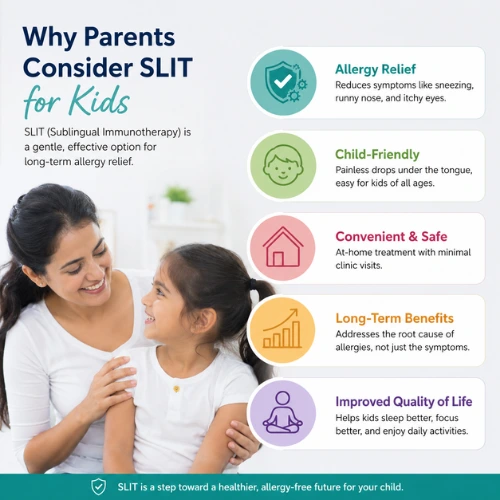
Many parents reach a point where they feel their child is constantly on medication.
A child may be:
- Sneezing every morning
- Sleeping poorly because of nasal blockage
- Missing school due to repeated symptoms
- Struggling with concentration because of disturbed sleep
- Developing worsening asthma or eczema triggered by allergies
In such cases, parents naturally start looking for a longer-term solution rather than a cycle of temporary relief.
That is where SLIT becomes attractive. It offers a treatment path that aims to change the allergy pattern itself, not just mask it.
The Pros of SLIT for Kids
Let us look at the main advantages first.
1. It Is Needle-Free and Child-Friendly
One of the biggest reasons parents prefer SLIT is that it does not involve injections.
Traditional allergy shots (subcutaneous immunotherapy) can be effective, but many children are frightened of needles or find repeated clinic visits stressful.
With SLIT:
- No regular injections
- Less fear and anxiety for the child
- Easier acceptance in younger children
- More practical for long-term treatment
For many families, this alone makes SLIT much easier to consider.
2. It Can Be Taken at Home
Once the child has been properly assessed and the treatment is started under medical guidance, most SLIT regimens can be continued at home.
This means:
- Fewer clinic visits
- Better convenience for busy parents
- Less disruption to school schedules
- Easier long-term compliance
For families in Dubai and other busy urban settings, this convenience is a major benefit.
3. It Targets the Root Cause, Not Just Symptoms
This is one of the most important benefits.
Most allergy medicines help control:
- Sneezing
- Runny nose
- Itching
- Nasal blockage
- Mild allergy flare-ups
But they do not “teach” the immune system to stop overreacting.
SLIT aims to gradually reduce immune hypersensitivity. That means some children may experience:
- Less severe symptoms over time
- Fewer allergy flare-ups
- Reduced need for daily medication
- Better tolerance to environmental triggers
This is why immunotherapy is often seen as a disease-modifying treatment rather than just symptom control.
4. It May Help Prevent Allergy Progression
In some children, untreated allergies do not stay limited to sneezing or a runny nose.
Over time, the “allergic march” can progress from:
- Eczema in infancy
- Food allergies
- Allergic rhinitis
- Asthma later in childhood
While every child is different, well-selected allergy immunotherapy may help reduce the risk of allergies becoming more severe or expanding into related airway issues.
This is especially relevant when a child has a strong family history of allergies or persistent symptoms year after year.
5. It Can Improve Daily Quality of Life
Parents often underestimate how much chronic allergies affect a child’s daily functioning.
A child with uncontrolled allergies may have:
- Poor sleep
- Mouth breathing
- Irritability
- Reduced focus in school
- Fatigue
- Poor appetite at times
- Frequent upper respiratory complaints
When allergies are better controlled, the improvement is often noticeable not just medically, but behaviorally and emotionally too.
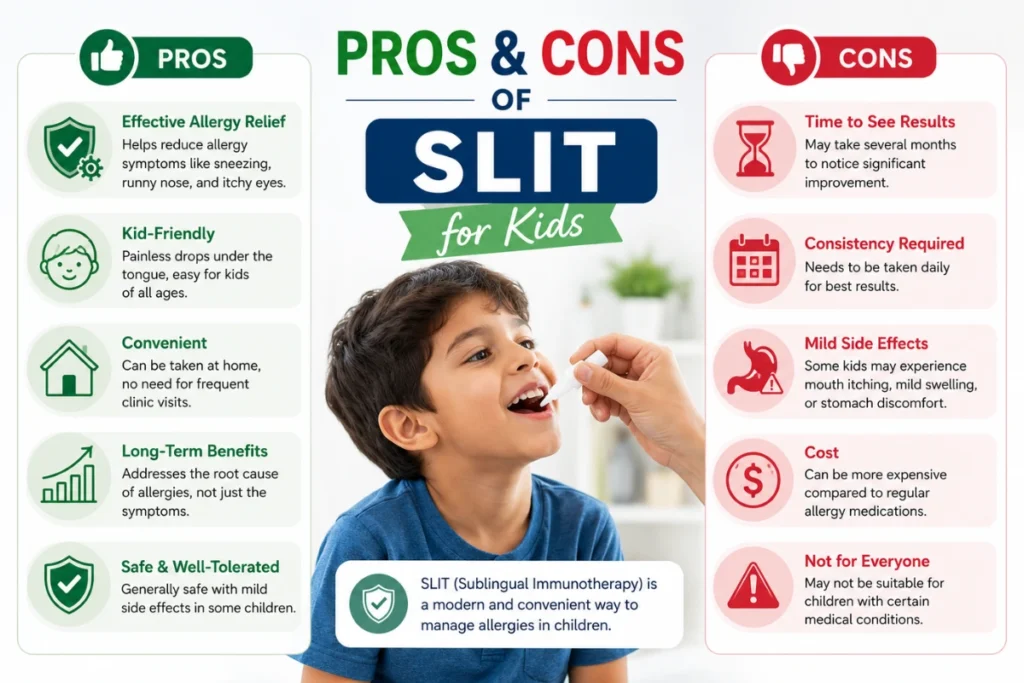
The Cons of SLIT for Kids
Now, let us be practical. SLIT is helpful, but it is not perfect for every child.
1. It Is Not a Quick Fix
This is one of the biggest misconceptions.
SLIT does not work like an antihistamine that gives relief in a few hours.
It usually requires:
- Regular daily or scheduled dosing
- Several months before a clear improvement is noticed
- Long-term commitment, often over 3 years, in many protocols
That means parents need patience and consistency. If doses are skipped frequently, results may be disappointing.
2. It Only Works for Specific Allergies
SLIT is not a universal treatment for all allergic conditions.
It is most commonly used for certain inhalant allergies, such as:
- House dust mites
- Pollens
- Some environmental allergens
It is not automatically suitable for every food allergy, every rash, or every eczema problem.
A child needs a proper allergy evaluation first, which may include:
- Detailed history
- Clinical examination
- Skin prick testing
- Allergy-specific blood tests when needed
- Correlation of symptoms with confirmed allergens
This is very important because treating the wrong allergen or using SLIT without proper diagnosis is unlikely to help.
3. Mild Side Effects Can Happen
Most children tolerate SLIT well, but mild side effects can occur, especially early in treatment.
These may include:
- Itching in the mouth
- Tingling under the tongue
- Mild throat irritation
- Lip discomfort
- Mild nausea in some cases
These are usually temporary and often settle as the body adjusts.
Serious reactions are uncommon, but because this is still an allergy treatment, it should only be started and monitored by an experienced pediatric allergy specialist.
4. It Requires Strong Parent Compliance
SLIT sounds easy because it can be done at home, but that convenience can sometimes become a challenge.
Because there are no regular injections at a clinic, some families may:
- Forget doses
- Stop treatment too early
- Expect immediate results and lose motivation
- Skip follow-up reviews
For SLIT to work well, parents must treat it like a long-term structured therapy, not a casual supplement.
5. It May Not Replace All Medications Immediately
Another important point: starting SLIT does not mean all allergy medicines stop overnight.
In the early months, some children may still need:
- Antihistamines
- Nasal sprays
- Inhalers if asthma is present
- Skin care if eczema coexists
Over time, medication needs may reduce, but this varies from child to child.
Common Parent Concerns Around Steroids and Behaviour
Many parents of children with allergies or eczema are also worried about skin treatments, especially steroid creams. Online searches often include questions like do steroid creams cause ADHD, and concerns about eczema steroid behavior side effects.
It is important to clarify this carefully.
Standard, appropriately prescribed topical steroid creams used correctly for eczema are not the same thing as SLIT, and they work in a completely different way. Misuse, overuse, or applying the wrong strength without guidance can create skin-related side effects, but parents should avoid jumping to conclusions based on social media claims.
There are also ongoing discussions around atopic dermatitis and ADHD, and some parents worry about the behavior of children on topical steroids. These topics are complex and often misunderstood. In real-life pediatric practice, it is far more important to evaluate the child as a whole: sleep quality, itch severity, inflammation, allergy triggers, family history, and whether symptoms are being managed appropriately.
This is exactly why specialist-guided treatment matters. One symptom should never be interpreted in isolation.
Which Kids Are Good Candidates for SLIT?
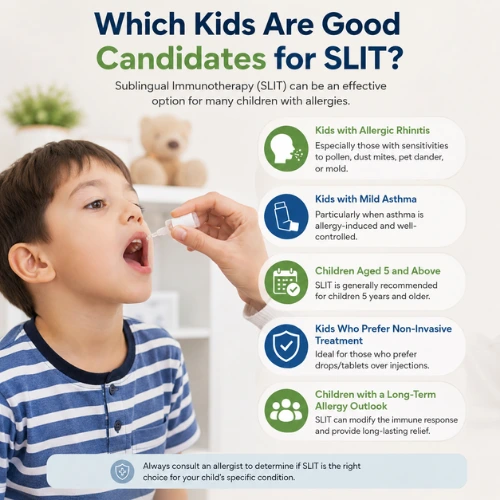
SLIT may be worth considering if your child has:
- Confirmed allergic rhinitis
- Dust mite allergy
- Seasonal pollen allergy
- Recurrent allergy symptoms despite medications
- Symptoms affecting sleep or school performance
- Mild asthma linked to allergies (after proper assessment)
- Difficulty with repeated clinic-based injection therapy
A child may not be the best candidate if:
- The diagnosis is unclear
- Symptoms are not truly allergy-driven
- The family cannot commit to regular dosing
- There is uncontrolled asthma
- There are specific medical reasons that need caution
This is why proper pediatric allergy assessment comes first.
What Parents Should Ask Before Starting SLIT
Before starting SLIT, ask your child’s allergy specialist:
- What exact allergen are we treating?
- How was this allergy confirmed?
- How long will treatment take?
- What improvement should we realistically expect?
- What side effects should we watch for?
- What should we do if a dose is missed?
- Will my child still need other allergy medicines?
- How often do we need follow-up reviews?
These questions help set realistic expectations and avoid frustration later.
Final Thoughts: Is SLIT Worth It for Kids?
For the right child, SLIT can be a safe and effective long-term allergy treatment that goes beyond temporary symptom relief. But it should always be started after proper allergy testing and specialist guidance.
If your child has persistent allergies, dust mite sensitivity, or symptoms that keep affecting daily life, book a consultation with Dr. Mahesh Katre for a personalised allergy assessment. Call +971 55 232 9107.