


According to the European Academy of Allergy and Clinical Immunology (EAACI) and the American Academy of Allergy, Asthma & Immunology (AAAAI), an Oral Food Challenge (OFC) is considered the gold-standard test for confirming or ruling out food allergies when a child’s medical history and allergy test results are inconclusive.
During the test, a child eats gradually increasing amounts of a suspected food under the close supervision of a pediatric allergy specialist. The child is carefully monitored for allergic reactions, helping determine whether the food can be safely included in their diet or should continue to be avoided.
Food allergies can make even simple, everyday moments feel stressful for parents. A school snack, a birthday party, a restaurant meal, or a small bite of something new can suddenly become a source of worry when your child has had a possible reaction before.
Many parents are left with the same questions: “Is my child truly allergic?” “Can we try this food again?” “Was the test result enough?”, or “Are we avoiding too many foods unnecessarily?” This is where an Oral Food Challenge may help, especially when the allergy history and test results do not give a clear answer.
For families in Dubai, where children are often exposed to diverse cuisines, school meals, travel, playdates, and social events, a clear food allergy diagnosis is an important part of managing children’s allergies. The goal is not only to know what your child should avoid, but also to understand what may be safely included in their diet.
Food allergies affect an estimated 6–8% of children worldwide, making accurate diagnosis essential to avoid both allergic reactions and unnecessary dietary restrictions.
What Is an Oral Food Challenge (OFC)?
An Oral Food Challenge is a medical test used to check whether a child reacts to a specific food when they eat it under close supervision.
During the test, the child is given very small amounts of the food first. If there are no symptoms, the amount is gradually increased in planned steps. The medical team observes the child between each dose.
The food being tested may be something your child has reacted to before, or something that showed a positive result on a skin prick test or blood test.
Common foods tested during an Oral Food Challenge may include:
- Milk
- Egg
- Peanut
- Tree nuts
- Wheat
- Soy
- Sesame
- Fish
- Baked milk
- Baked egg
The exact food depends on the child’s history, age, symptoms, previous test results, and the allergy specialist’s assessment.
Why Allergy Tests Alone May Not Always Be Enough
Many parents feel anxious when they see a positive allergy test. But one important thing to understand is that a positive test does not always mean the child will definitely react when they eat that food.
Skin prick tests and blood allergy tests can show sensitisation. This means the immune system has recognised a food and produced allergy-related antibodies. But sensitisation is not always the same as a true clinical allergy.
For example, a child may test positive for egg but may still tolerate baked egg in cakes or muffins. Another child may have a borderline result to peanut but may never have had symptoms after eating it.
That is why a pediatric allergy specialist looks at the complete picture, not just one report.
A proper allergy assessment usually includes:
- What food was eaten
- How much was eaten
- How quickly symptoms started
- What symptoms appeared
- Whether the child needed medication
- Whether breathing, swelling, vomiting, or dizziness occurred
- Whether the food has been eaten again since then
- Skin prick test or blood test results
- Asthma, eczema, or other allergy history
When the history and test results do not match clearly, an Oral Food Challenge can help answer the question more confidently.
Who Needs an Oral Food Challenge in Dubai?
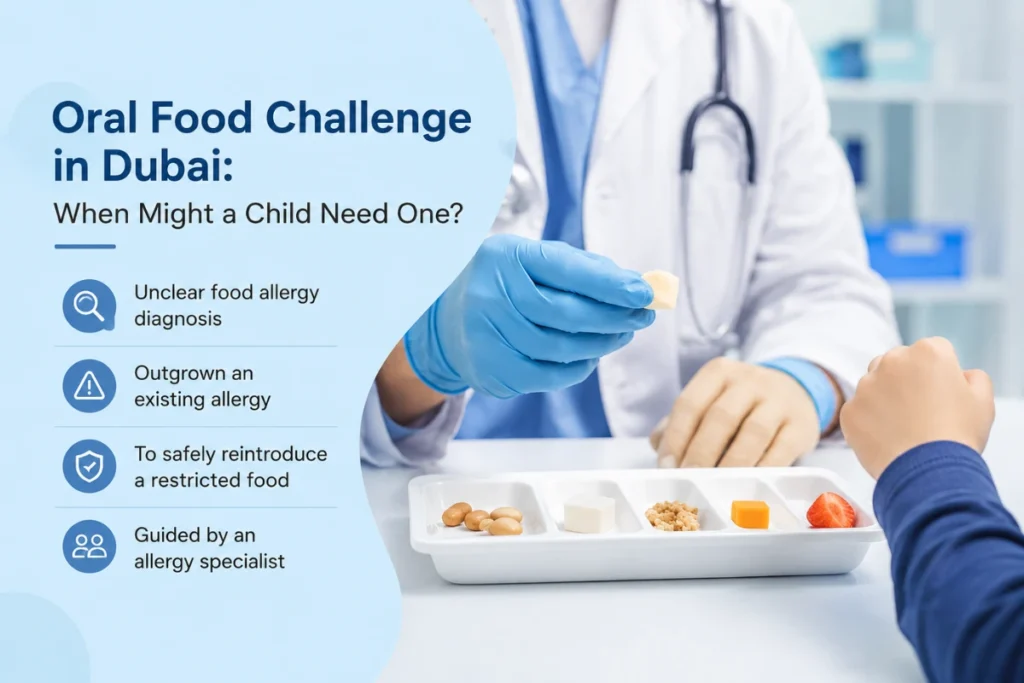
International guidance, including recommendations from the National Institute for Health and Care Excellence (NICE), supports specialist assessment when a child’s clinical history and allergy test results are inconclusive. In such situations, an Oral Food Challenge (OFC) may be recommended to confirm or rule out a food allergy accurately.
Clinical experience shows that some children with positive skin prick or blood test results can safely tolerate the suspected food during a medically supervised Oral Food Challenge. This demonstrates why allergy test results should never be interpreted in isolation but alongside a child’s symptoms, medical history, and specialist evaluation.
1. To Confirm a Suspected Food Allergy
Sometimes, a child may develop a rash, vomiting, swelling, or coughing after eating a certain food. But the reaction may not be clear enough to confirm an allergy.
For example, a rash may have appeared hours later, or the child may have eaten several foods at the same meal. In such cases, it can be difficult to know which food, if any, caused the reaction.
An Oral Food Challenge may help confirm whether the suspected food is truly the trigger.
2. To Check If a Child Has Outgrown an Allergy
Some childhood food allergies can improve over time, especially allergies to milk, egg, wheat, or soy.
If your child has been avoiding a food for years and recent test results look more reassuring, the allergy specialist may suggest a supervised challenge.
This can help check whether the child has developed tolerance and whether the food can be safely reintroduced.
3. To Avoid Unnecessary Food Restrictions
Avoiding food may feel safer, but unnecessary food restriction can create other problems.
It may affect:
- Nutrition
- Growth
- Mealtime confidence
- Family meals
- School lunch planning
- Social events
- Parent anxiety
For young children, removing important foods without a confirmed allergy can sometimes make feeding more stressful.
An Oral Food Challenge can help families avoid over-restriction when it is not needed.
4. To Guide Long-Term Child Allergy Management
Food allergy care is not only about a diagnosis. It is also about creating a practical plan for everyday life.
A supervised food challenge can help guide decisions around:
- Safe food reintroduction
- Continued avoidance
- Emergency action plans
- School and nursery instructions
- Travel preparation
- Future allergy reviews
- Possible desensitisation options in selected cases
For parents, this means moving from guesswork to a clearer plan.
Many children with cow’s milk or egg allergies develop tolerance as they grow older. For this reason, allergy specialists may recommend reassessment over time, and an Oral Food Challenge can help determine whether these foods can be safely reintroduced into a child’s diet.
Food Allergy Testing Comparison: SPT vs. Serum IgE vs. OFC
Although skin prick tests and blood tests are valuable tools for identifying allergy sensitisation, they cannot confirm whether a child will develop symptoms after eating a particular food. According to international allergy guidelines, an Oral Food Challenge remains the gold standard for confirming or ruling out a food allergy when the diagnosis is uncertain.
| Diagnostic Feature | Skin Prick Test (SPT) | Specific Serum IgE (Blood) | Oral Food Challenge (OFC) |
| Primary Measurement | IgE antibodies bound to mast cells in skin | Free IgE antibodies circulating in blood | Real-time clinical physiological reaction |
| What It Proves | Sensitisation (Immune awareness) | Sensitisation (Immune awareness) | True Clinical Allergy or Tolerance |
| Accuracy Level | High sensitivity, higher false-positive rate | High sensitivity, higher false-positive rate | Gold Standard (Highest diagnostic accuracy) |
| Procedure Time | 15–20 minutes | Single blood draw | 2–4 hours under supervision |
| Anaphylaxis Risk | Negligible | None | Low to Moderate (Fully managed clinically) |
Benefits of an Oral Food Challenge for Children
Oral Food Challenges help confirm or rule out food allergies, reduce unnecessary dietary restrictions, improve nutritional intake, and support accurate long-term allergy management in children. It can be very helpful for both the child and the family when it is done for the right reasons.
1. It Can Provide Clarity
One of the biggest benefits is clarity.
Parents often live with doubt after a possible food reaction. They may keep asking, “What if it happens again?” or “Are we being too cautious?”
A supervised challenge can help answer whether the child reacts to that specific food or not.
This can be reassuring, especially when parents have been avoiding food for a long time without a definite diagnosis.
2. It Can Help Expand the Child’s Diet
If the child passes the challenge, the allergy specialist may advise adding the food back into the diet.
This can make a big difference, especially when the food is common in everyday meals, such as milk, egg, wheat, or nuts.
A more varied diet can support nutrition and make mealtimes easier for the family.
However, parents should always follow the doctor’s exact instructions after a challenge is passed. Passing one form of a food does not always mean every form is safe.
For example, tolerating baked egg does not automatically mean a child can eat lightly cooked egg. Tolerating one nut does not automatically mean all nuts are safe.
3. It Can Reduce Fear Around Food
Food allergy does not only affect the body. It affects the whole family’s routine.
Parents may feel worried at birthday parties, school events, restaurants, hotels, flights, and even family gatherings.
When a food allergy is ruled out, it can reduce a lot of daily stress.
Even when the challenge confirms an allergy, parents leave with better clarity about what to avoid, what symptoms to watch for, and what to do in an emergency.
That confidence matters.
4. It Can Support School and Nursery Safety
In Dubai, many children attend nurseries, schools, camps, after-school activities, and playdates where food exposure can happen.
A clear allergy diagnosis helps parents give accurate instructions to teachers, caregivers, and school nurses.
It also prevents unnecessary restrictions that may make the child feel different when they do not need to be.
5. It Can Help Plan Future Allergy Care
Food allergies can change as children grow.
Some children may outgrow certain allergies. Others may need continued avoidance and regular follow-up. Some may be suitable for further allergy treatments or desensitisation discussions, depending on the case.
An Oral Food Challenge helps the specialist make decisions based on the child’s real response, not just test numbers.
What Are the Risks of an Oral Food Challenge?
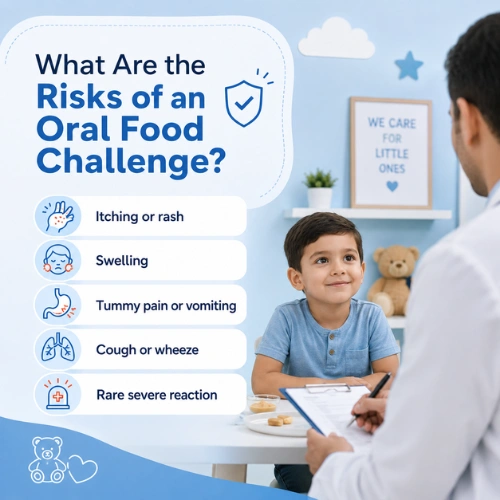
An Oral Food Challenge does carry risk because the child is eating a food that may cause an allergic reaction.
This is exactly why it should only be done in a supervised medical setting.
Possible symptoms during a food challenge may include:
- Hives
- Redness or itching
- Swelling of the lips, eyes, or face
- Vomiting
- Tummy pain
- Coughing
- Wheezing
- Throat discomfort
- Breathing difficulty
- Dizziness
- Looking pale or unwell
- Anaphylaxis in rare cases
Most reactions during a properly supervised challenge are mild and can be managed. But serious reactions can happen, so the team must be prepared with the right medicines, equipment, and emergency care.
Parents should not try a food challenge at home if their child has a suspected allergy, a history of immediate reactions, breathing symptoms, swelling, repeated vomiting, or anaphylaxis.
When Is an Oral Food Challenge Not Recommended?
An Oral Food Challenge may need to be postponed or avoided if the child is not well or if the risk is considered too high at that time.
The allergy specialist may delay the challenge if the child has:
- Fever or an active infection
- Recent vomiting or diarrhoea
- Uncontrolled asthma
- Recent wheezing or breathing difficulty
- A severe eczema flare
- Recent allergic reaction
- Poorly controlled allergy symptoms
- A medical condition that may increase the risk during a reaction
This does not always mean the child can never have a challenge. It may simply mean the timing is not right.
Safety comes first.
How Should Parents Prepare Before the Test?
Preparation is an important part of the Oral Food Challenge process.
The clinic will usually give specific instructions based on your child’s case. Parents should follow these carefully and ask questions if anything is unclear.
Share the Full Reaction History
Before the challenge, tell the allergy specialist exactly what happened during previous reactions.
Try to include:
- The suspected food
- The amount eaten
- The timing of symptoms
- The type of symptoms
- Any medication given
- Whether emergency care was needed
- Whether the child has eaten the food again
- Any asthma, eczema, or other allergies
Even small details can help the doctor assess risk.
Ask About Medicines
Some medicines can affect the results of a food challenge.
For example, antihistamines may need to be stopped for a few days before the test, depending on the doctor’s advice.
Do not stop any regular medication on your own. Always follow the instructions given by the allergy specialist.
Make Sure Your Child Is Well
If your child is unwell on the day of the challenge, inform the clinic.
Symptoms like fever, cough, wheezing, vomiting, diarrhoea, or a severe eczema flare may mean the test needs to be rescheduled.
It is better to postpone than to take unnecessary risks.
Bring the Food If Asked
Some clinics may ask parents to bring the food being tested in a specific form.
This could be milk, egg, peanut butter, a baked muffin, biscuit, or another prepared food.
Do not change the form of the food without asking the clinic, because the form of the food can affect the result.
Plan Enough Time
An Oral Food Challenge can take several hours.
The child needs time between doses and observation after the final dose. Parents should keep the day free and avoid rushing to school, work, or another appointment immediately afterwards.
Bring something quiet to keep your child occupied, such as books, toys, colouring materials, or a tablet with headphones.
What Happens During an Oral Food Challenge? A Step-by-Step Guide
The exact protocol may vary, but the overall process is usually quite structured.
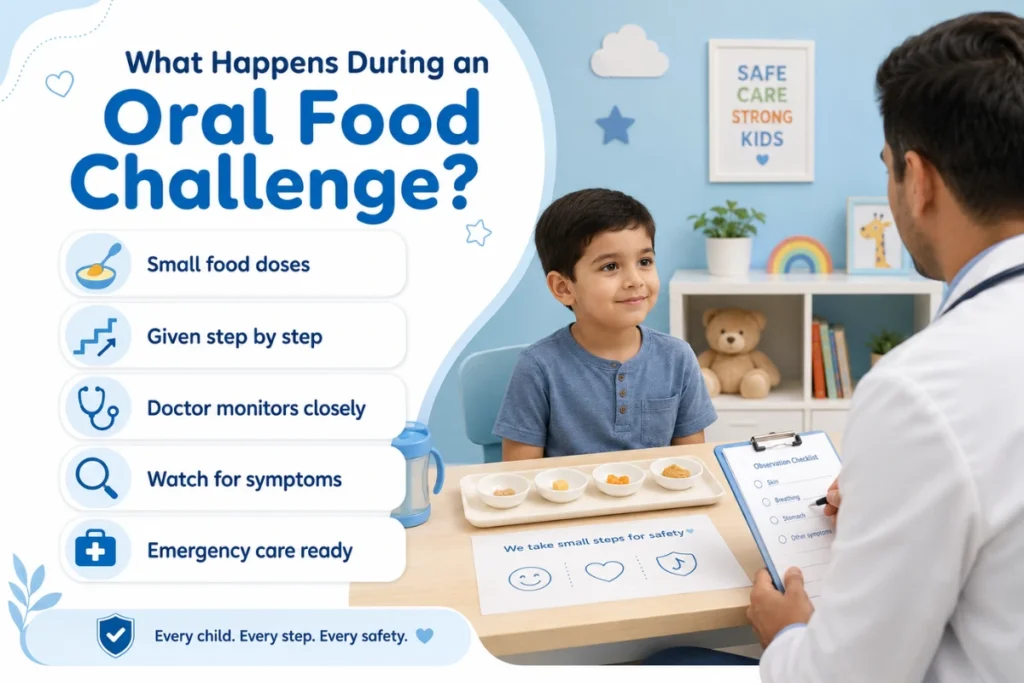
Step 1: Initial Assessment
Before starting, the medical team checks whether your child is well enough for the challenge.
They may ask about recent symptoms, medicines, asthma, eczema, and any new reactions.
Step 2: First Small Dose
Your child is given a tiny amount of the suspected food.
This first amount is usually much smaller than a normal serving.
Step 3: Observation
After each dose, the team watches for symptoms.
Parents may also be asked to report anything unusual, such as itching, tummy discomfort, throat symptoms, coughing, or a sudden behaviour change.
Step 4: Gradual Increase
If there are no concerning symptoms, the child receives gradually larger amounts of the food at planned intervals.
The process is slow and careful. The aim is not to rush, but to test safely.
Step 5: Stopping If Symptoms Appear
If symptoms develop, the doctor will assess whether the challenge should stop.
Treatment may be given depending on the reaction.
This may include antihistamines, inhalers, observation, or emergency treatment if required.
Step 6: Final Observation
If your child completes the challenge without symptoms, they will still be observed for some time before going home.
The doctor will then explain the result and what to do next.
What Does It Mean If the Child Passes the Challenge?
If your child passes the Oral Food Challenge, it usually means they tolerated the tested food during the supervised appointment.
This is reassuring, but it is still important to follow the doctor’s instructions after the test.
The allergy specialist may advise:
- How to introduce the food at home
- How often should the food be eaten
- What form of food is suitable
- Whether any other foods still need testing
- Whether school or nursery instructions can be updated
Parents should not make broad assumptions after one challenge.
For example, passing a baked milk challenge may not mean fresh milk is safe. Passing peanut may not mean all tree nuts are safe.
Each food needs clear guidance.
What If the Child Reacts During the Challenge?
If your child reacts, the medical team will manage the symptoms and stop the challenge if needed.
A reaction is not a waste of the appointment. It gives important information.
It can confirm that the food still needs to be avoided and helps the doctor understand the child’s level of sensitivity.
After a positive challenge, the doctor may discuss:
- Food avoidance advice
- Label reading
- Emergency medication
- Whether an adrenaline auto-injector is needed
- School or nursery allergy plans
- Follow-up testing
- When to reassess in the future
For parents, this can bring structure to what previously felt uncertain.
Can Parents Try a Food Challenge at Home?
No, not if there is a suspected food allergy or a history of allergic symptoms.
A true Oral Food Challenge should be supervised by trained medical professionals because allergic reactions can be unpredictable.
In some low-risk cases, a doctor may advise home introduction of a food. But that is different from a supervised Oral Food Challenge.
Parents should not decide this on their own.
If there has been swelling, breathing difficulty, repeated vomiting, hives, dizziness, or anaphylaxis, the food should not be tried at home without specialist guidance.
Why Specialist-Led Child Allergy Management Matters in Dubai
Food allergy care should be practical, not frightening.
Families in Dubai often manage busy school schedules, international travel, mixed cuisines, birthday parties, hotel stays, and family gatherings. Children need allergy care that fits real life.
A pediatric allergy specialist can help parents understand:
- Whether the child truly has a food allergy
- Which foods need strict avoidance
- Which foods may be safely introduced
- What symptoms are concerning
- How to manage accidental exposure
- When emergency medication is needed
- How to guide schools and caregivers
- When to review the allergy again
This kind of support helps parents feel more confident and helps children participate in everyday life with better safety.
Why Choose Dr Mahesh Katre for Paediatric Allergy Care?
Dr Mahesh Katre is a UK-trained paediatrician and pediatric allergy specialist in Dubai with experience in diagnosing and managing childhood allergies. His expertise includes food allergies, drug allergies, anaphylaxis, allergy testing, oral food and antibiotic challenges, allergy desensitisation, immunotherapy, eczema, asthma, allergic rhinitis, FPIES, and respiratory allergies.
Every Oral Food Challenge is planned around your child’s medical history, allergy test results, and overall health. During the test, your child is given small amounts of the suspected food in a controlled and supervised setting. They are closely monitored throughout the procedure, and the medical team is fully prepared to manage any allergic reaction if it occurs.
Dr Mahesh understands that allergy testing can feel stressful for both children and parents. That’s why every effort is made to create a calm, child-friendly environment where families feel comfortable, informed, and supported from start to finish.
After the challenge, Dr Mahesh takes the time to explain the results in simple terms and answers any questions you may have. Parents also receive personalised advice on which foods their child can safely eat, what should still be avoided, and the next steps for managing their child’s allergy with confidence.
Every child is different, so treatment is never based on test results alone. Dr Mahesh considers your child’s symptoms, medical history, lifestyle, and nutritional needs to create a personalized allergy care plan that supports their long-term health and wellbeing.
Conclusion
An Oral Food Challenge in Dubai can provide parents with clear answers about whether a suspected food allergy is still present or if a food can be safely reintroduced under specialist supervision. For expert pediatric and allergy care, consult Dr Mahesh Katre in Dubai. Call or WhatsApp +971 55 232 9107 to schedule a consultation and receive a personalized allergy assessment and management plan for your child.
FAQs on Oral Food Challenge for Children
Is an Oral Food Challenge painful?
No, the test itself is not painful. Your child eats small amounts of food under supervision. However, if a reaction happens, symptoms may be uncomfortable and will be treated by the medical team.
How long does an Oral Food Challenge take?
It usually takes several hours because the food is given gradually and the child is observed between doses and after the final dose.
Is an OFC safe for young children?
It can be safe when done for the right child, at the right time, in the right medical setting. The allergy specialist will decide whether your child is suitable based on history, test results, and current health.
What foods can be tested during OFC?
Common foods include milk, egg, peanut, tree nuts, wheat, soy, sesame, fish, baked milk, and baked egg. The food selected depends on your child’s allergy history.
Will my child need to stop allergy medications before the test?
Yes, certain allergy medications, particularly antihistamines, may need to be stopped before an Oral Food Challenge because they can affect the test results and mask allergic symptoms.
Does passing the challenge mean the allergy is gone forever?
Not always. Passing means your child tolerated that specific food in that specific form during the test. The doctor will advise how to continue it safely at home.
What happens if my child fails the challenge?
If your child reacts, the test is stopped and symptoms are treated. The doctor will then explain what the result means and how to manage the allergy going forward.
When should I consult a pediatric allergy specialist?
You should consult a pediatric allergy specialist if your child has experienced a suspected allergic reaction to food, has recurrent allergy symptoms, or has positive skin prick or blood test results that require further evaluation.